
Big, Little, Big/little and Little/big

Contents
Chapter 3: 17:00
Chapter 4
Big, Little, Big/little and Little/big - issues of intimacy
Addition for the m/other-us-all
Introduction
This month, I’ve found myself preoccupied with whether we can really make a difference to the big things happening in the world. I’ve been asking myself questions about the time I spend crafting these posts each month, and my desire to operationalise our m/other tongue.
Is it worth it?
Is it just self-indulgence?
Does what I’m saying make a difference?
Is it just my opinion, or ‘real’ research?
If it is my opinion, shaped as it is by practice, literature, and Heuristic Inquiry, and if you are scrutinising and critiquing these ideas before deciding whether to use them, why would this not be research? Why would it not be valid knowledge that raises questions of how the world, and the individuals in that world, can change to become more alert to the multiverse and trans-verse - i.e. operationalise our m/other tongue by moving from keeping going to keeping growing?
It would be easy to feel defeated if I get too caught up in my desire to change the horrors of the world. That feels far too big. Writing these posts is, for me, a significant act with a deeply personal impact. It is part of how I make sense of my work with children and families over the years, and of my place in this world as a woman who feels on the margins of the manstream. It is also an attempt to share that thinking with you in a way that is both grounded in research and usable in practice.
And yet, in the big scheme of things, these posts are little. Around 300 people read them each month. I don’t know whether my little offering of my big thinking to a little number of you has a big or little impact on you as you go about your daily life of care towards others. This makes the notion of ‘generalisability’ as a marker of high-quality research unravel for me. My mind boggles. What feels big today may feel little tomorrow, and what seems little today may seem big in many years’ time, but I can’t say for whom and when or why.
So, the fiction has led me to consider how little actions have big impacts and what this may mean as we learn to live by our m/other tongue.
Rest
They all rested. The room rested. As if the overwhelm of losing the light and only gaining some back, of realising how little it took to lose what was deemed essential (such as purchasing goods) and then realising the world did not come to an end, of learning that they could sit quietly alongside others without having to do anything or get to know anyone, had exhausted them.
Behind the serving counter there was no rest. Several young men in branded polo shirts and hair coverings huddled together. They barely spoke, caught between the hush of rest and… their colleague. Every so often one threw a glance over his shoulder, then was pulled back into the small group, phones out, hopefully prodding at news, looking for an exit from this stuckness, a way home. Unsettled by…
The stainless steel countertop was stark and cold. Hygienic. Easy to clear. Five-star food hygiene rating. Like a bomb shelter.
Sarfan was not resting.
His back was hard against the wall behind him. His eyes were wide, staring. His body rocked occasionally as he hugged his bent knees as tightly as he could beneath the stainless steel. His mind played all the stories. Un-unrememberable memories of things he wished his body had never encountered. Pain showed on his face, the corners of his mouth pulled down. His attempts to retain dignity fought tears. He worked hard not to move his cheeks, not to give his eyes any chance to leak. He knew this place. He knew that if he just kept staring he could hold this in-breath rigidity for many hours if he needed to. He knew he could stop the out-breath that would bring even the tiniest relaxation to breaching the fortification. He could, would, must do the stopping of sound - muffled voices, shouting, the echo of empty dark space - that smell - oil, death, unwashedness - feeling the cold hand of a brother - leaving a body, just a few leaves to cover dignity. Where? Fragments. Who knew where his brothers lay. The cold. The cold that shuddered you to your core. Your cold, their bodies’ coldness. Food. How could they leave food here. He grabbed the angular strut of the stainless steel counter, hard, making its coldness cut into his hand. Holding on. Leaving food to waste. Just because. No way to take money. It made them like the traffickers. Money – only if money. Not promise of money, money now. Life jacket if money.
And today he could not run away so he could hold this in-breath alone. He could feel the way he stunned his work colleagues. He knew their subdued chatter was fear of him, not fear for him. He knew they felt his desperation, and thought him dangerous for it. He felt they had seen the dishonesty he was: that he was alive when his brothers were dead, that he was a criminal, an illegal, even though he was moral and kind. He could not compute this and shook his head. He saw, in the eyes of those he served their burgers and drinks, the knowledge that he was nothing, as disposable as the cups the drinks came in. Used and discarded. He dared not think about his grandmother. He would never stop the tears if he let himself feel that her love and her hopes had come to this. And he longed, and longed, and longed for her.
Hold the in-breath. Hold the in-breath. Don’t breathe out.
19:30
Daniel’s phone pinged. It was Sandra.
Cars and minibus approaching north side of services. Unable to use motorway. Police facilitating access on foot from parking outside station. Will let you know when ready to collect children from service station. Estimate half an hour.
Daniel tried to piece together the meaning of the text, trusting that Sandra would get the right information to him at the right time. He took his time to breathe, feeling Jacob and Mia still pressed to his sides, knowing they would detect the increase in his heartbeat as he considered the best way to inform his staff, and the safest way to shepherd the children through the crowd and over the bridge without triggering a contagious stampede that would overwhelm them. The problem was that overwhelm often led to a need to fight or flee, and then it became a struggle to keep everyone safe.
His life was one of constant forward planning and over-engineering, ensuring, as far as possible, that structures were in place for the children to feel safe enough to enjoy engaging with the world around them, so they could grow. Structure, nurture, structure, nurture – so that there were small flashes of engagement and challenge in the quality of his relationships with the children, and often with the parents too. He could never let his guard down either, though not in the defensive way the children kept their guards up - rather, in the manner of a matriarch of the herd, knowing all the subtleties of care and guiding his staff into that understanding over time. Although it was a specialist unit, he was exceptionally proud of the low staff turnover, exceptionally proud of how the children settled, and exceptionally protective when anyone – including inspectors – wanted to look at paperwork before talking to the children.
He let his mind drift. He had found this the best way to problem-solve while still holding the embodied space needed to keep the children calm. As soon as he shifted into overt, cognitive problem-solving, they detected his psychological absence. In this drifting, he wished he had sought out Val earlier and asked her to be a consultant in his development. He had never thought about it before, but now he named his decision-making technique as ‘doing a Val’.
What did ‘doing a Val’ mean to him? Visualising the process, walking it through in his mind’s eye, knowing how his body might respond, feeling into each child, each adult, and how they might react as they navigated the clusters of people on the floor and at tables. He registered the smells, and reckoned Nina would be triggered by that woman over there, who probably wore strong perfume. He might be wrong, and there was no judgement in his evaluation of her – although, at the same time, there was, because it hurt the children he cared for. He knew Jayden would need to pee by now, but the toilets here would be beyond their capabilities - just far too many sensory assaults. Better to get them to the other side and connected up with their carer, and then they could pee safely in the bushes. But their physical need would make them super sensitive on the walk across.
He needed his staff completely focused on the children. So he’d need a guide and a tail walker to manage the journey part.
He glanced over at Val and the man she was with. They looked content, aligned. He wondered if they might help. He began to work out how to use the half hour to set up the systems that would make it possible to rescue the children.
His ‘doing a Val’ came to an end with a plan in mind. It had been a rare lapse of awareness and self-control to drop a kiss onto Jacob’s head earlier. He felt the desire to do the same again, to both Jacob and Mia; it always seemed the natural conclusion to a decision-making process that placed the children at its centre. He knew it might be seen as inappropriate for a male professional, especially one in a position of authority, to act in that way. But he always felt it through, in his mind’s eye. He called it visioning. Even if it could not happen in the external world, he had learned that imagining and feeling it, not merely thinking it, created a different internal space within in him which led to a different relational space between him and the child, or whoever he was caring for. And that governed his action. He never denied his love for the children he worked with, or for his staff, but he chose carefully how to honour it.
As happens with visioning, as the plan fell into place inside of him, it was as if the world around him aligned too. Val looked up. He caught her eye and she sent him a question. He leaned his head back slightly, indicating he would like her to come over. He saw her nudge the man beside her, who seemed sleepy and took a moment to rouse. Val placed her hand under his chin and smiled at him, and he smiled back. Her lips moved as she spoke. The man paused, then his mouth formed an “oh”, and he nodded. Slowly, they both stood, looked around, and began to make their way over towards Daniel and the group of children in his care.
Big, Little, Big/little and Little/big - issues of intimacy
I don’t know what you might have made of last month’s post. I’m not sure what I made of it. It seems to bring together big stuff and little stuff in a way I didn’t quite work through. That is the process of this open air Heuristic Inquiry: you are seeing the messy, intermediary, steps of me groping towards some sense of coherence. I’m afraid this is another of those messy, not quite there yet explorations.
The fiction about Sarfan is also messy. I intended it to be a bit incoherent to reflect his turmoil, but when re-reading it, at times it seemed incomprehensible. Each time I read and edit and chew over the fiction I shake my head and sigh as I try to work out what it is mirroring to me of the tacit maternal knowing that I utilise as a clinician, therapist educator, a researcher, and manager of services that care. What is it I am trying to understand as I use this research process? How can I find a sensible way to convey how to operationalise our m/other tongue? How do I show the value of putting tacit maternal knowing at the centre of decision and policymaking with the mother/infant relationship as our reference point for valid knowledge? When is that the best reference point in our intention to care for others both in the human multi-verse as well as the trans-verse realm?
In other words, I keep trying to work out for myself how I can stop being stuck in the manstream. I don’t want to climb out of the sticky toolbox and just get stuck in another place. The changing bag could be as restricting and uncreative as the toolbox if used in the wrong place at the wrong time. So how can I discern which ways of seeing the world are most helpful to care for those in front of me? Of course, that presupposes that the drive we have in our lives is to care, not to make a profit. I can only own that for myself. That is my priority. It’s like that for me, is it like that for you too?
Care as my priority crystallised (drawing on Ellingson, 2009) for me through my experience of becoming a mother, being a Theraplayer, and then being baffled that it was not obvious to others that it is vital and powerful to position the mother/infant relationship as the primary reference point in the uncovering of knowledge and changing the world. It seems a fracture of logic to me that this embodied, pre-verbal source of data is not given the same level of power as the cognitive and abstract. This, I am coming to realise, is one of the things that is at the heart of operationalising our m/other tongue: this keeping the mother/infant relationship as our primary reference point for knowledge generation and honouring the lived body of knowledge that comes from that.
However, I find my head has been preoccupied with doubts that have popped up in conversations in different forms and in different places over the past few weeks: aren’t self-search methodologies in research just indulgent? Isn’t what you’re doing only useful to one person, to you? How is this relevant to everyone? Such doubts could certainly get in the way of curiosity and joyful exploration if I didn’t have the Structure of my research methodology to hold me. In the end, I can only trust the Heuristic Inquiry process and, despite the doubting voices sitting on my shoulders, do my usual literature search strategy based on the search terms that the immersion, incubation, and illumination phases of the Heuristic Inquiry process push me to encounter.
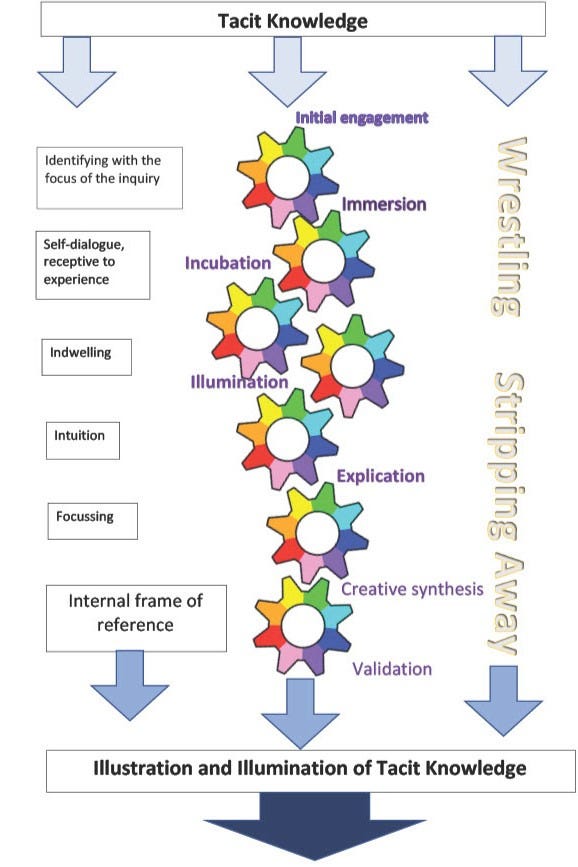
This engagement with literature, through information encountering (Erdelez 1999), is an cyclical process. The fiction throws up a felt-sense curiosity that words arise from. I throw those words into various arenas and see what comes out (no, not like gladiatorial combat, more like throwing seeds into soil and seeing what grows). Each idea I bump into - from peer-reviewed papers, books, news articles, personal writings from others that pop up on the internet - takes me back to the fiction for a further in-depth personal search and review of the meaning my tacit knowing is trying to make available to me.
The cycles of seeking meaning this month have centred on trying to work with my preoccupation with how the little – or the local, individual, highly contextual, arts-based research process – and its resulting knowledge might connect to the bigger process of using our m/other tongue in our work. And how the little might shape our understanding of the biggest world happenings at the moment – see me combining nappy changing with the Straits of Hormuz last month.
That literature review process led me to read Crisis? What Crisis? (Turner, 2013) about Britain in the 70s. I am a child of the 70s. I am shaped by my genetic make-up and my family relationships and, as I realised while reading the book, by world events. But I don’t remember those events as oil crises, three-day weeks, or big political and global moments. What I actually remember is a neighbour handing a casserole over the fence because she had a gas cooker and thought we only had an electric one.
I remember felt experiences, not prime ministers, oil crises, or talk of wars. That big stuff clearly impacted daily life, but the greatest impact on me, and on how I am influenced to live my life today, was the little stuff of home life. Little events in the little community of which I was part. Little events caused by big events in the world. And what I carry forward, what shapes my decision-making, is Mrs Stanners – her piano, her paintings, her casserole dish; her seeing of me, and her kindness.
(I am curious whether other members of my family remember this event in the same way, or whether it has become some sort of emblematic ‘memory’. I would have been about five, so by then my episodic memory would have begun to stabilise beyond the embodied memory of infancy. Perhaps that is why that moment of intimacy – Mrs Stanners standing by the fence in her apron, handing over the casserole dish – is available as a narrative that sits on the cusp between memory of a real event and something that captures an experience.)
My exploration of the history of the 70s, alongside my personal memories, suggests that what informs the choices I make as a person, and as a professional, are intimate moments of connection with others, not the grand sweep of politics. Of course, the two are interdependent. The casserole may not have become a punctuation point - a pause of time that means the tacit knowing emerges into the realm of a fixed knowledge - if the three-day week hadn’t cut off the electricity. Mrs Stanners would still have been the caring person she was (or I remember her to be), but that care may not have been so visible to me as a child had big events not precipitated her little act.
Daniel’s kiss on Jacob’s head is another such punctuation point, making his care visible. He remembers Val playing with Joe at a time when he was questioning whether teaching was for him. He did not remember, or even know about, the policies that created the conditions for her work. It was the little, local, contextual experience of witnessing her practice that altered the direction of his life, and led him to make big differences in the lives of the children he now works with.
The little is big - but we already know this. We have theories that tell us so. In attachment theory, it is described as the formation of internal working models. Yet giving it a name, rendering it as theory rather than as a felt, enlivened narrative, can, in my experience, diminish the impact of how little experiences can have big consequences in how we conduct ourselves in relation to others in the big world arena.
So, back to the research process. I immerse, incubate, and illuminate through information encountering. I then explicate through my daily writing practice, returning to the creative synthesis of my tacit knowledge - the fiction - and finally I seek validation. I remind myself that I am a Theraplay practitioner who researches. I close my eyes, hold tight, and go over the rollercoaster edge, using Challenge as part of growing. I use Structure to keep myself safe by following the same pattern of research each month - but it remains deeply exposing.
On the 15th of each month, I share the draft with my editor, who sees the unsureness and messiness. They are one version of the world. My first, tentative step towards validation of what I am trying to articulate, from someone I trust to be kind in their honesty.
Simply sharing what I am trying to make sense of in my own mind helps to crystallise it further. This is about intimacy – not sexual intimacy, nor exclusively adult-to-adult intimacy, but the intimacy through which small acts, such as casseroles passed over fences, are what make meaning of the big things, such as the post-war power struggles between unions and government, as well as the colonised and the colonisers. One does not need full knowledge of the large forces shaping the small to feel their impact. Casseroles over fences, Val playing with Joe, Daniel placing a kiss on Jacob’s head – these are the moments that change people, and that prime them to make choices about how they live in the world. It is the little, local, contextual, and personal that, in my experience, creates big, lasting change, because of the power of intimate connection.
And so, back again to the beginning of the Heuristic Inquiry process: immerse, incubate, illuminate, encounter literature. Who else is thinking about intimacy in this way?
I didn’t find much. Wynne and Wynne (1986), and Gunkel (2024), writing nearly forty years later, both suggest that intimacy remains an under-theorised area. Both focus primarily on adult-to-adult relationships, although Wynne and Wynne were, I think, notably ahead of their time in recognising the white, Western bias in their thinking. Groarke (2010) writes about an infant observation he undertook, noting that the infant invites intimacy and the mother responds. However, his observations begin only after five weeks, whereas I am interested in the pre-mobile play stage and what happens there in terms of identity formation and the internalisation of a felt sense of safety, where the more powerful other takes the play towards the infant.
Kittay (2011) considers intimacy in relation to disabled adults – insightful work, but again not centring the mother/infant relationship as our primary reference point for the generation of knowledge, which is the defining feature of working with our m/other tongue. Other literature tends to focus on intimate partner violence – again, adult-to-adult relationships, often sexualised, becoming the primary frame of reference. Gunkel (2024) also explores how torture can be an intimate act, though clearly not one oriented towards flourishing, where trust and empathy are absent.
Developing an understanding of intimacy, and how it relates to operationalising our m/other tongue, involves making sense of how power is used when it flows from tacit maternal knowing. It becomes one of the resources in our ‘changing bag’, with the mother–infant relationship as the primary point of reference.
Wynne & Wynne (1986, p.384) define intimacy as:
a subjective relational experience in which the core components are trusting self-disclosure to which the response is communicated empathy. Intimacy may be asymmetrically complementary, with one person disclosing more than the other. It is important to recognize that self-disclosure, in itself, does not necessarily generate intimacy - for example, when divorcing couples use self-disclosure to “prove” how little they care for one another. Rather, a key component is the willingness to share, verbally or nonverbally, personal feelings, fantasies, and emotionally meaningful experiences and actions, positive or negative, with the expectation and trust that the other person will emotionally comprehend, accept what has been revealed, and will not betray or exploit this trust.
Although this definition addresses adult-to-adult intimacy, it contains features that are useful here. Gunkel’s (2024) attention to the bodily dimensions of intimacy – particularly the distinction between wanted and unwanted touch – is also helpful. I think of Daniel’s kiss on Jacob’s head: Jacob’s discomfort with it, yet how he does not reject the intimacy, just uses it in his interior space to moderate his actions of care.
So how might a perspective on intimacy, grounded in the mother–infant relationship, inform our operationalisation of our m/other tongue? And how does the fiction help me work this through?
Because of their early experiences, neither Val nor Graham has been able to sustain an intimate relationship as defined by Wynne and Wynne (1986), except perhaps with their pets. In them, we see the big impact of little acts of misattunement, despite their parents’ best efforts. Without exposure to intentional cruelty, Val and Graham are nonetheless working hard to find a felt sense of safety within themselves - enough to enable an intimate relationship with each other. They are aware that something is missing. They might be described as having ‘earned secure attachment styles’ (Pearson, 1994), yet there remains a vulnerability within that security, visible in their struggles to connect. They are unwilling to share with each other for fear of misattunement and the shame it can bring. They use their professional power benignly, in the service of others, but it tends to flow in one direction. The mutuality of intimacy eludes them, and this is a source of sadness.
Sarfan was deeply loved. He had a home and a family where he belonged. The society around him may have held dangers, but with his brothers and his grandmother, even after the loss of his mother and father, he carried an inner felt sense of safety – the kind that comes from a secure base and underpins good mental health. But even that good mental health is eroded, or fractured, by exposure to too much for too long and the removal of those who could help him with it (my definition of trauma).
Sarfan is broken by a last straw - thinking food will be wasted. Despite the emotional security of his early life, and the big impact of those little acts of care and affection, his inner peace can’t hold together after exposure to repeated feeling-injury during his journey to the UK and his treatment once he arrived. His vulnerability is demonised because of his big political context of being ‘illegal’. Without the intimacy of his family relationships, that vulnerability is overwhelming.
Val and Graham, by contrast, never had sufficient early intimacy. They adapted and survived, but without a stable felt sense of safety. Sarfan had it, and lost it – and the impact is devastating.
Daniel’s early experiences leave him with that felt sense of safety, a secure attachment style, yet he still encounters the challenges of the world – as a gay man in a caring profession, and as someone who initially felt that teaching was not for him because of the way school positioned the relationship of teacher and child. But he has achieved intimacy: with his husband (though that comes later in the fiction), and with the children he works with. Seeing Val work with Joe gave him a glimpse of something different. His underlying sense of safety, even within a challenging cultural context, afforded him the agency, curiosity, and privilege to do something different.
Attachment theory tells us that if you have been loved in a way enables a felt sense of safety, you tend to encounter the world as safe, and respond to others accordingly, unless proven otherwise. If, instead, you are treated as an object of ridicule or emotional harm, you may come to experience yourself in those terms, responding defensively or aggressively in order to protect yourself. This is, of course, a broad generalisation (and it raises the question of why generalisability continues to be treated as a marker of research quality).
What I am pointing to is that what is internal becomes external: it is the inner world that colours interaction and shapes decision-making. We tend to treat others in ways that echo how we ourselves have been treated, and how we are able, or unable, to hold ourselves with care. “Love your neighbour as yourself” has always seemed to me less a command than a description.
For all the characters in the fiction, it is early experiences of care – including the many ways of being touched, physically and emotionally – that establish the foundations for how they live in the present. Taking the mother/infant dyad as our primary reference point in knowledge generation, touch is a fundamental component in the formation of a felt sense of safety. Skin is the first place of touch, before ‘being touched’ becomes a purely emotional experience. Another cycle of the research process emerges here.
Within our m/other tongue, then, if we take the mother–infant relationship as primary, intimacy appears to involve a bodily, touch-based dimension; a congruence between how one is felt by others and how one feels oneself to be; and a form of agency that arises from having been physically and emotionally held in attuned ways.
This is not new knowledge: it has been theorised before, just not under the term ‘intimacy’ in relation to tacit maternal knowing. The words of theory themselves seem to have pushed away the embodied experience of intimacy, somehow diluting the felt-sense of how I would characterise that word and what it means in our m/other tongue. Don’t try to understand what attachment theory says: try to feel what it means.
Bick (1968) introduces the idea of the skin as an emotional container. Manning (2009, p.2) asks what might happen if neither skin nor self were taken as the starting point for the complex, interrelational matrix of being and worlding. Manning argues that Bick is not relational in her thinking because she focuses on self and other, not self/other - the interdependent relationship that I see as part of speaking our m/other tongue. Manning sees Daniel Stern (1985; 2006) as having a more interrelational stance with multiple layers of the self existing prior to self-awareness and language. She develops this into a notion of momentary cohesion with dreams of containment.This comes close to what I am describing, though it does not fully capture what I see as living in the m/other tongue. It does, however, hold a sense that it is relationship - without the need for communication by words, relationships that are communications of the body - that are part of the foundation of felt-sense-of-safety as a precursor and necessary anchor for intimate connection.
Daniel is intimately connected to the bodies of his pupils in a maternal, not sexual, way, although the risk of this being misinterpreted weighs heavily on him. But that physical touch is necessary for the development of a felt sense of safety. It also becomes entangled in little political and big Political contexts. Gunkel (2024) helped me think this through, particularly in relation to touch as both vulnerability and connection, and how one might render oneself ‘untouchable’ as a defence against experiences of annihilation – for instance, through the development of a narcissistic stance.
Sarfan, however, remains open to connection. That need overrides any pressure to align with the manstream. Yet his ‘deviance’ – giving away food instead of binning it when there was no way to take money for it - has significant consequences. It breaks him. He does not have the defensive strategy to protect himself. His skin is thin, but in a way that comes from a healthy psychological starting place - yet is now in a wholly unhealthy external arena for his inner health to survive.
Skin can be understood as skin, or as concept – that is part of the complexity I am trying to articulate. Theraplay, too, can be Theraplay or concept: a way of working in a therapy room, and a way of thinking about the world. These are not separate. Theraplay is big – a way of seeing. It is little - the act of a bean bag drop. It is little/big, because that beanbag drop can contribute to changing the course of a family’s life. It is big/little because, in this manstream world, the sound of the m/other tongue is unhearable and unretainable. Otherwise, why would so many of us say similar things, and yet find them not taken up as a valued way of living? This is the big, the little, and the little/big and big/little. All of it matters.
As I work to understand what the fiction is revealing about my tacit knowing, I find myself increasingly struck by the complex interplay of the little relationship stuff that we think about in connection with attachment theory, and the big world stuff of government policy, shaped in turn by the inner lives of those who create it.
Trying to speak from my m/other tongue (and still feeling not entirely fluent, as I continue to work this through), I find myself thinking that this research is relevant to everyone. Each of us began as an infant and was mothered – for good or ill, for better or worse, in sickness and in health, richer or poorer - and, until we die, that mothering has impact. So what if it is only useful to one person, if it transforms that person’s life from surviving to thriving? Isn’t that really big? Isn’t this that peace, or felt sense of safety, I was writing about last month? And might a community of people living from that sense of safety begin, in some measure, to shift the direction of the wider world?
It is striking to me that, without conscious intent, my language echoes that of the Church of England wedding service – a form historically used to legitimise adult sexual intimacy. Yet that history is also one in which women were ‘given away’, positioned as possessions transferred from father to husband. That organising principle – the ownership of one person by another, based on visible difference – is precisely what I am trying to make visible, and to challenge. I find myself drawing on similar phrasing – in sickness and in health, for richer or poorer, for better or worse – but reframing it as a maternal commitment: to care regardless, not as possession, but as interrelationality; as a choice to use one’s power in the service of the less powerful other, not to diminish them, but to facilitate their thriving.
Intimacy - when used in the motherland, articulated via our m/other tongue - illuminates the direct connection between the little, personal, highly contextual, relational and attuned or misattuned experiences of one person and the big multi-versal and trans-versal experiences in a bidirectional and interdependent way. That is a more compressed, more ‘academic’ way of expressing what I have been circling in more descriptive terms for the last few paragraphs!
As a resource from our ‘changing bag’, intimacy involves the person with more power choosing to use that power to attune to the other, so that the other can experience themselves as seen, valued, and, perhaps, even adored – in an embodied way, and within the particular limits that relationship requires. Gunkel (2024) wrote about how torture can also be highly intimate. While not wanting to diminish the hideous nature of torture, this did remind me of the act of tickling. The embodied connection of tickling treads such a fine line between delightful connecting joy and something that becomes intrusively painful. What holds that line in the realm of connection is the attunement of the tickler to the embodied experience of the person being tickled, and the tickler being ready to stop when the line is crossed, even if they are enjoying the experience of tickling. This is why the little experiences of care (or lack of care) make big differences in the hands of those who wield power.
Powerful people who lack a felt sense of safety, and who operate within the norms of WSCP and WEIRD frameworks, may express their inner worlds through big world actions and impose their power over others. They avoid tender intimacy because it opens their vulnerability, and they inflict intimate cruelty on others by not knowing when to stop. For them, people like Sarfan are not cared for, but vilified.
This line between tickling being fun and being torture is so fine that, within Theraplay, it is generally avoided in sessions. The ambiguity of the intimacy involved makes it difficult to hold safely in the immediacy of the session.
However, when, through a maternal frame, we understand that fine line between intimacy that enables growth and intimacy that harms, we gain clearer direction for how to use intimacy as professionals who care. It reframes the purpose of the use of power, which helps us hold the challenge of how our little, contextual, individual offering can have big consequences through creating and sustaining intimacy.
Yet, we don’t need to know (in a cognitive or measurable manner) whether these consequences occur, because in operationalising our m/other tongue, the focus shifts: value is not in the outcome, but in the quality of the process of relationship.
Addition for the m/other-us-all
In our m/other tongue, the more powerful takes responsibility for shaping the conditions in which the less powerful other can grow and flourish, through the use of intimacy. In any given moment, whoever has greater power is responsible in the sphere of influence gifted to them. Big influence comes from little acts of intimate care toward those who are vulnerable rather than big actions on the world stage.
Bibliography
Bick, E. (1968) The Experience of the Skin in Early Object-Relations. International Journal of Psychoanalysis 49:484-486
Ellingson, L. L. (2009). Engaging crystallization in qualitative research: An introduction. Sage.
Erdelez, S. (1999). Information Encountering: It’s More Than Just Bumping into Information. Bulletin of the American Society for Information Science and Technology, 25(3), 26–29. https://doi.org/10.1002/bult.118
Groarke, S. (2010). Making contact. Infant Observation, 13(2), 209–222. https://doi.org/10.1080/13698036.2010.488001
Gunkel, J. (2024). What Is Intimacy? The Journal of Philosophy, 121(8), 425–456. https://doi.org/10.5840/jphil2024121833
Ings, W., & Tudor, K. (Eds). (2025). Heuristic enquiries: research across disciplines and professions. Routledge. https://doi.org/10.4324/9781003507758
Kittay, E. F. (2011). The Ethics of Care, Dependence, and Disability. Ratio Juris, 24(1), 49–58. https://doi.org/10.1111/j.1467-9337.2010.00473.x
Manning, E. (2007). Politics of touch: Sense, movement, sovereignty. University of Minnesota Press.
Manning, E. (2009). What if it didn’t all begin and end with containment? Toward a leaky sense of self. Body & Society, 15(3), 33–45. https://doi.org/10.1177/1357034X09337785
Moustakas, C. E. (1990). Heuristic research: Design, methodology, and applications. Sage.
Pearson, J. L., Cohn, D. A., Cowan, P. A., & Cowan, C. P. (1994). Earned- and continuous-security in adult attachment: Relation to depressive symptomatology and parenting style. Development and Psychopathology, 6(2), 359–373. https://doi.org/10.1017/S0954579400004636
Stern, D. N. (2006). The interpersonal world of the infant: A view from psychoanalysis and development psychology. Karnac.
Turner, A. W. (2013). Crisis? What Crisis? Britain in The 1970s. Quarto.
Wynne, L. C., & Wynne, A. R. (1986). The quest for intimacy. Journal of Marital and Family Therapy, 12(4), 383–394. https://doi.org/10.1111/j.1752-0606.1986.tb00671.x
You write about the “vital and powerful position of the mother/infant relationship as the primary reference point in the uncovering of knowledge and changing the world,”
and how
“On the 15th of each month, I share the draft with my editor, who sees the unsureness and messiness… My first, tentative step towards validation of what I am trying to articulate.”
Both make me think about early relational dependence in the formation of knowledge.
I know you’ve mentioned the valuable work of your editor in a few posts and I find myself wondering about your relationship with them and how this informs your writing process.