
What are we responsible for? What’s our job?

Contents
Chapter 3: 17:00
What are we responsible for? What’s our job?
Addition for the m/other-us-all
Introduction
New year, new direction? Or revisiting the same foundational ideas with a different perspective and sharper insights to enable the operationalisation of our m/other tongue? Who knows!
If we take the mother/infant dyad as our primary point of reference, I see our role in life as being our best so that others can grow. I hold this to be true in mothering real, flesh-and-blood children, and for m/othering theory, clinical practice, art-making, management of services, and research.
When I first re-read this month’s allotted fiction, one of the questions you set me as a research focus came to mind:
Caring for the bad mother: when we meet the child’s experience of the ‘bad’ mother in play, how does our tacit knowledge allow us to deepen our sense of how to care for that person both in the representation we get left with, as well as when we meet the actual mother
I find myself wanting to challenge the notion of the ‘bad’ mother, or the bad parent, while still accepting that there are people in the world who are wantonly cruel and pathologically anti-social. These are the people that, last month, I suggested would always be outliers in our human communities, and who require care-full containment. The alternative to such care-full containment risks either negative judgement – care-less containment (the worst aspects of imprisonment) – or, conversely, fearfully giving them space to become leaders.
Over my working life, encountering such wantonly cruel or pathological anti-social people has been rare. When I have, it has seldom been within the therapeutic frame. More often than not, I have found them in leadership roles. Most parents I have worked with have been doing their best in difficult circumstances, shaped by their own stories, and by those of their parents, and their parents’ parents. They are surviving within systems that are care-less and judgemental, demanding immediate change without regard for the slow and painful process of working through many generations of Othering.
In the research shared through these posts, I am currently thinking about systems rather than the people within them. However, the two cannot be separated – people and systems are inextricably entwined. Both personal history and systems have a negative impact on children’s lives. But are caregivers who care deeply, yet draw from a very limited reserve of skill, energy, and support, truly bad? I prefer to think of them as parenting within highly complex contexts, inside systems that are not responsive or personalised to maximise the effort such parents are making.
Later in the fiction, Val approaches her mother and finds some kind of resolution for herself. Currently, still trapped in the service station that holds memories of how her mother entrapped the young Val in conditions that undermined her sense of being wanted or belonging, Val recalls, in a dream-like state, caring for Joe after Shell left him and the children.
Both Shell and Joe grew up in the care system. They appeared to find stability and fulfilment in each other, and in the family they create between them. However, the pull of the family of origin proved too strong for Shell when her father was released from prison and reasserted control over his family. She left Joe and the children, returning to drug use and low-level criminality. Supervised contact between Shell and the children was stipulated by Social Care. Joe manages the contact sessions himself, at a contact centre. Shell does not always turn up.
Mothers
Val drifted. Despite the hardness of the floor. Despite the noise. Maybe because of the intensity of so many humans compressed into a small space, unable to flow away from each other, her mind went elsewhere. Not asleep, but in another state.
The pressure on her arm grew, telling her Graham was asleep.
Her mind weaving, a bit from here, a bit from there. Surviving the unsurvivable. The moral deepness of keeping going. Being responsible. Not neglect. Not control.
The weavings came together in a visceral memory: Joe, sobbing on her arm. The pressure like Graham’s sleeping head now. Heavy. Fragments of his sobbing voice.
“I love her, Val.”
“Why can’t she put us first?”
“Should I stop contact?”
“I want to see her, Val.”
All the sobs - his, hers, children’s, clients’, carers’ - weaved into one. His story a mini world of so many other stories. Little moments of devastation in the headlong rush of life: getting children to school, setting up a business, cleaning and cooking and shopping, containing and holding Niks and Sammy, and carrying on because this was normal. But it wasn’t normal.
“I love her, Val. Is that so wrong?”
“I can’t stop loving her, Val. She is my love.”
“I can’t be angry with her, Val, and I’m angry with her.”
The outpouring was utterly painful. There was little she could say, and still she had to find words.
“Joe, you carry on loving her. Joe, you know her. Joe, you can let the children know the inside her, the loving her.”
“Was it just a dream, Val?”
“No, Joe. She loved you and the children. It’s just stuff. Stuff that was so strong.”
It was hard, so hard, for Joe, Niks, and Sammy. Shell carried on being part of their life even though she was absent, gone, lost. She carried on being the children’s mother in the stories Joe told them, in the pictures he showed them on his phone: playing in the park, making silly faces, eating ice cream with the children, pushing them on swings.
He took them to the contact centre and played with them, and cooked for them, and made it a day out. When she didn’t come, they were unaware that she had failed them, because they had had time in a special place with their dad. They never questioned why they went there once a month on a Saturday morning, or why all those other families did the same.
It was Joe who came away ravaged by Shell’s absence, the gap she left in his life that he sought to fill with his extra holding of the children. He felt ragged in his need to fiercely keep the space for her, even when social workers said to stop, it’s not good for the children. But look, he said, do you see any damage to my children by me coming here with them in case she comes? They couldn’t say there was. Both Niks and Sammy were thriving bodily and flourishing at school.
“You carry on loving her, Joe,” Val had said.
She’d carried on loving Joe as the little tearaway boy who could hardly respond to her care. Nickie had carried on loving Joe when he became too violent to remain in the foster home. It was their carrying on loving him that made the space for him to come back to loving them, when he was able. It made no sense. They didn’t know how it would turn out. They just kept loving him because he was lovable. They imagined him into loveliness and loved that, and he grew into being loved.
“You carry on loving her, Joe,” Val had said, even though she knew the costs of loving someone who couldn’t love themselves. She admired his courage and offered him her shoulder to cry on, a place to share the cost of love.
Tea
She must have shifted from survival zoned-outness to dozing at some point, because there was a definite moment of waking up.
Val tried to move, then scrunched up the muscles of her face and her back. She was stiff. Graham stirred at that point too.
“Sorry,” Val said, as she tried to mobilise her left arm. It felt like someone was banging a nail into her shoulder blade. As much as she tried to move it up and down, right to left, she just couldn’t quite access the muscle that must have clenched to the point of pain as she dozed in discomfort.
“For what?” Graham said, also a bit foggy.
“I disturbed you.”
Graham looked at her and then indicated the whole room with his hand. It was as if, as his hand swept around the space, someone turned up the volume knob, the noise increasing with his sweep.
“I don’t think it was you!”
Val smiled and glanced at her watch. The doze that had felt like hours was, in fact, only ten minutes at most, her watch telling her it was approaching six.
“I’ll get us some tea.”
“Sure.”
She needed to move as much as anything, although a warm drink would be appreciated as a possible way to ease the stiffness from sitting on a hard, cold floor, her back against a wall and a man against her arm.
She rose to her feet slowly, using the wall for support and planning her route to the fast food serving counter. The feeding frenzy that had accompanied the closing of the motorway seemed to be over. She picked her way to the counter, where the servers were standing, waiting for what might happen next.
“Two teas, please,” she asked.
It was the young man who’d served her before, the young man with the accent and the English she’d found hard to understand. He smiled at her. He remembered her because of the warmth she’d managed to convey to him, even though he knew she hadn’t got what he’d said. She’d been unusual. He often got hostility and accusations of being an illegal immigrant. He was - but that wasn’t the same as being immediately treated like a criminal. The philosophy degree he’d abandoned in his home country really didn’t help with the just getting on with the reality of his life now.
“Order there,” he said, pointing to the interactive computer boards which took both money and desires, and made it possible for him to take this job because verbal interaction was reduced and, along with it, awkward questions about his status.
Although his words were curt, they didn’t sound aggressive to Val because of his body language and tone. His face was warm, his shoulders flexible and open. He felt concern for this older woman as he looked at her, crumpled, her hair at odd angles and her body clearly stiff and struggling to move. He saw the dismay on her face when she realised she needed to negotiate the boards. What had been a giggle with Graham when they had energy and time, now felt like an insurmountable obstacle to what she needed. She turned away, not really sure she had the energy to grapple with such technology.
“Wait,” the young man said. “Stop.”
She turned back to the counter.
He held up his hand. “Wait,” he said again.
He glanced quickly at his colleagues, who were absorbed in conversation and looking at someone’s phone. Seeing they were distracted, he quickly pulled two paper cups from the pile, two tea bags, and two shots of hot water from the everlasting boiler. A large handful of milks was pushed towards her. Val proffered her credit card, but he shook his head, looking almost scared.
“No, no,” he said. “You go.”
“Thank you,” she replied, not smiling at first. She was puzzled, then realised the kind risk he was taking, and then was utterly grateful and wanted to make sure he didn’t get into trouble for his thirty seconds of unpaid sharing of hot water, tea bags, cups, milk, and human kindness.
“Thank you,” she said again, with much deeper understanding.
His nod was imperceptible as he turned away and disappeared behind some equipment, only to reappear with a bucket and a mop, showing everyone, especially his colleagues and shift supervisor, that he was diligent and busy, not squandering the profit margin of shareholders who both demanded cheap labour and decried the small boats.
What are we responsible for? What’s our job?
Caring for the bad mother: when we meet the child’s experience of the ‘bad’ mother in play, how does our tacit knowledge allow us to deepen our sense of how to care for that person both in the representation we get left with, as well as when we meet the actual mother
My leadership is that of motherhood – invisible, responsive, serving the needs of others. I feel it is not seen or valued and, so, I feel unseen and unvalued. Often, I have also felt de-valued and that can make me angry. I am not a proactive person in terms of imposing action on others - rather, I am proactive in setting the conditions to facilitate the growth of the other, based on what I see, feel, imagine, and sense they are capable of. Exemplary maternal leadership is about enabling, seeing, responding, creating the conditions for the flourishing of the other, catching and soothing when there is a fall or when it becomes too much, and then resetting the challenge. I explored this in posts from August and September, thinking about maternal leadership as being a conductor and questioning what work might be. Last month, I declared that we do have the answer – it’s love. Being a leader in our field is about taking some responsibility for being intentional in our choices of how we put that answer into practice in our professional lives. That is how we care for the ‘bad’ mother.
As you can see from the introduction, I find it easier to be positive towards the challenges flesh and blood parents (of all types) face than I do towards systems that fail vulnerable people. The question you set me was about direct practice. At the moment, in the still early days of this open air Heuristic Inquiry, I am more focussed on the background things that stop me/us doing what we know is the thing to do. The actions that grow from the answer are obvious (to me), the theory is obvious (to me, albeit at the moment I am struggling with a language for that theory - what Jeanette Winterson the symbolic representation of inner states), and yet somehow we are kept living in societies that are divided and, frankly, systemically cruel to those who are vulnerable, like miserable hamsters on wheels that we can’t slow down for long enough to get off. I cannot, therefore, separate the above question from another you set me:
How does our m/other tongue tell us to fight against or work with a system that was created by and continues to be controlled by white patriarchal ideology? How do we remain fulfilled and in a place of caring about self and others. Give in, fight, be part of, work within????
In the fiction, Joe manages to separate his job of mothering/loving his children from his soulmate/love for Shell. She has let him down, and the children too. He carries on keeping the maternal space available for the children through the way he makes, constructs, plans, and engages with the processes of daily care, contact, and positive memory management - but the cost to him is huge. He is torn apart by the contracting hopes and expectations he holds, but he sticks with it and builds on the observable evidence of the actual impact on the children in the story – Niks and Sammy. He stands up to the system that would avoid the horrible pain caused to him by his mothering work by pointing to the living evidence of the children. He responsibly and intentionally makes action choices based on operationalisation of tacit maternal knowing. He’s not professionally trained, he has no qualifications, but he knows what his children need.
As I reflected on the fiction and on what my tacit maternal knowing was trying to bring to my awareness, I found myself, again, trying to extract myself from the toolbox. I followed my usual information-encountering process, becoming curious about the morals and ethics of responsibility in development. Initially, the papers and books that came to me focused on the WEIRD world, on the economic development of countries that are deemed less wealthy or developed than they. Drydyk and Keleher (2019) in the Routledge Handbook of Development Ethics sought to examine the issue from multiple perspectives, but I didn’t feel there was any true challenge to the assumption of the WEIRD as an expected position of desire: something higher up a hierarchy, a “better than” position. Even when I changed my strategy and explored theories and responsibilities of child development in Western and Indigenous academic literature, the books and papers were, well, WEIRD. So, what do I do as researcher, practitioner, carer, leader? Give in, fight, be part of, work within?
The system, as I grapple with the operationalisation of our m/other tongue, feels to me like a bad mother. The system is not attuning to me, it is not leading me (or those of you who maybe see things the way I do), it is not multisensory or in the here and now. It is not playful. It is not helping me grow in the way that fits for me. The system is not Theraplay. Theraplay creates a changing bag; the system creates a toolbox. Theraplay creates the place where care can happen, so that humane facilitation, not in-human neglect, can lead to development.
How do you care for the bad mother when that bad mother is the system you are required to operate under? Like Joe, how do you keep offering opportunities for more positive connection if the Universe, as defined by the WEIRD and the WSCP, does not want it, or is too addicted to an alternative destructive, but familiar, path?
If capitalism will not play ball, then there is nothing you can do but hold onto your own position. Sarfan does not lose his desire to care, even though he has been subject to extreme care-lessness. Joe does not stop loving Shell, and he does not stop making space for her to be part of the children’s lives, while protecting them from the vicious impact of her neglect. He cannot protect them from the absence of her maternal love, but he works hard to prevent it becoming an active injury by providing his maternal love. He also finds places to express his woe in ways that can be received, in this case with Val.
So is this what we do with the neglectful parent that some of the systems we work in represent – systems that disguise themselves as mother-who-cares while being neglectful and exploitative? How can we be canny and subvert the manstream? Where do we slip the care in when the master is not looking, pretend we are doing what should be done, and then grieve that the bad mother will not play ball? And how do we remain ready if the bad mother – the master, the toolbox, whatever word picture we choose to identify the WEIRD and the WSCP – asserts its dominance over us as we try to keep caring for the vulnerable?
We do know. Part of my purpose in grinding out these posts each month is to test a language that does what Winterson says language should do – provide symbolic representations of inner states. The metaphors we live by in the manstream (to borrow from Lakoff and Johnson, 2003) are based on hierarchy, better than, strength, power, and so on, as the drivers of the Uni-verse. Ultimately, these metaphors are about the vertical organisation of human relationships: the drive to be one, individualism, top of the pile, a uni expression – being good by being better. In the m/otherland, our primary driver for organising knowledge is horizontal, or communal.
So if we are not subscribing to a notion of the Uni-versal, how do we conceptualise ourselves out of the toolbox and into the changing bag? In my wondering about a word that might capture the symbolic representation of the inner state of the m/otherland, whose first language is our m/other tongue, I arrived at the notion that when this is our homeland we do not live in a Uni-verse, we live in a Trans-verse.
In the Trans-verse, the primary point of reference in our theory-making – the signified (to use Saussurian ideas about linguistic construction, and if Saussure is new to you, try Gordon and Lubell, 2015) – is the preverbal, social, and right-brained experience of the mother and child. The written words, or the signifiers in Saussurian terms, are metaphors that grow out of that lived experience, or concrete phenomenon.
Our m/other tongue becomes about metaphors that arise from our bodies, and from body-to-body maternal communication. To find ways to communicate what we know, and to act through the intentional application of that knowing, we have to put ourselves as embodied beings on the line, and then make congruent sense of that. Sometimes we can care under the radar of the bad mother, but it does cost. Sometimes we can safely flout the rules of the bad mother, but it does cost. Sometimes we have to step into the firing line, and that will also cost. I am sure each of us can think of examples from our culture where people have been injured, or paid with their lives, during non-violent resistance to dominating powers.
What drives the choices we make is how to care for, and protect, those who are less powerful than ourselves (in any one moment) from the impact of care-less-ness. It is a dynamic process of least-bad possible outcomes that preserve the dignity of the other, and the dignity of self. And then, to word-make, to create a written language theory, we have to represent that experience as closely as we can.
(I am not ignoring body-to-body communication between adults in mature sexual relationships, but that is a different language code. The failure to discriminate between these different body-to-body languages may contribute to patriarchy. It all comes back to the choice about how power is distributed – power over, or power with. But that is a whole different exploration, and not for here today.)
As part of my information super-encountering, I ended up reading a book about the female body as the stronger sex (Vartan, 2025). It challenged many myths I have held about my own body, not only those related to pregnancy and mothering. It presented a powerful argument that bodies capable of menstruation are not less strong, but differently strong. Of course, sex differences are not as clear-cut as man or woman, capable of menstruation or not, conceiving, gestating, and birthing babies or not. Nor do I want to assume that people whose bodies are capable of menstruation will choose to become mothers through conception, gestation, birthing, and feeding infants, or to conflate those biological processes with the experiences of people of any gender who become mothers by their actions of mothering. Still, it did make me think about what women who become mothers might offer to the theory-generating world. The more I read, the more complex it becomes to tease out the concrete and the abstract, and to move from lived experiences of mother–infant connection, through theoretical formation, and then back into what this looks like in the practices of therapy, research, education, and management.
All of these binary in or out positions suggest either the perpetuation of a power hierarchy (signalled by language such as giving in or fighting), or the joining of something that is not overtly in-human, worth connecting to, or utterly immutable (signalled by language such as becoming part of, working within, or accepting that there is a right or wrong). In operationalising our m/other tongue, we are speaking an entirely different language, and not one that is purely verbal. When we are operating from our m/other tongue, we neither give in nor fight; we do not become part of, nor do we work within. These word forms are not metaphors of the Trans-verse and the changing bag. They are metaphors of the Uni-verse and the toolbox.
This is why it is so difficult to render our m/other tongue – the way of life that takes the foundations of Theraplay seriously – into theory within the WEIRD state. The toolbox and the changing bag are made of entirely different materials, and for entirely different purposes.
Using the metaphors of toolbox and changing bag, and saying that they are made of different substances, may sound like a ‘well, obviously!’ statement. Yet it feels as though, when it comes to generating theory that supports practice grounded in the mother–child phenomenon as our initial building block, in order to make concept, theory, and practice congruent, this obviousness has somehow been ignored.
Ignored, perhaps, because it would require people to realise, at a fundamental level, that women (whether they join that subset of women who become biological mothers or mothers in the way we are examining in this research) are as good as they are – that people are equals, as strong and as vulnerable as one another in different ways, but definitely equal. If there is genuine equality, then this sets the ground for interdependence as the foundation of development. It steps away from the patriarchal framing of development as independence that must be won from dependence.
Ann Jernberg asked us to use the mother and infant as the primary reference point for the newly established, and slowly maturing, therapeutic model of play therapy she named Theraplay. Theraplay is beyond its infancy now, and so can function both as a practice and as a way of thinking about how we organise our work, what we regard as our job, and what we are responsible for in this world. We may not all feel that using the changing bag is for us, or for the people we work with, or for the roles we inhabit, but it does deserve as loud a voice, and as much space, as the toolbox. Those of us who want to live by the changing bag, not the toolbox, have to take our space – and that is not easy.
In my information super-encountering this month, I was reminded that the Equal Opportunities Act came into force in the UK in 1975. I would have been eleven. My formative years were spent not only within a family culture where patriarchal values were regarded as proper values, but also within a wider society that confirmed women were not worthy enough, for example, to apply for a mortgage in their own right, or to be paid the same for undertaking the same role as a man.
What is the risk of taking the mother and infant as the primary reference point in theory development, organisational management, and clinical practice? One risk is the personal cost of challenging both the external WSCP and, more pertinently, the WSCP within. For me, at least, that internalised WSCP is the more limiting factor as I try to take my place in the world and advocate for our m/other tongue to become our mother tongue within our vocations. Being reminded of the developmental stage I was at when the law at least recognised equal rights for women brought home the challenge I face in dumping the toolbox for the changing bag.
But why is this any more of a risk than taking a patriarchal relationship – a male having power over those he regards as his inferiors, even if benign – as the primary reference point in theory development, organisational management, and clinical practice? The WSCP has simply become so normalised that we no longer question it as a valid position. We do not ask whether it is fit for developmental purpose, or whether it can be abusive by demanding the wrong type of work, at the wrong time, for the wrong purpose. Yes, it is scary to ask someone to move to another country, to the m/otherland, when all they have known is what they do not even know they know, because it was normality before a sense of self had developed.
Just as last month I claimed a position – we do have the answer, it is love – this month I am claiming another position: we do all have a common ground on which to meet, and from which to begin to find our points of connection.
Being conceived, gestated, birthed, and fed – these are our commonalities. We have all experienced them, for good or ill, in poverty or wealth, in discrimination or privilege, in the global north or the global south. How these stories play out may differ, but people who use their m/other tongue, whatever their gender, keep the mother–infant experience as the foundational block of all their endeavours. They keep love that enables the other (human or other living beings, including environments) to flourish and grow into the best they can be as both the starting point and the ending point of choice-making and decision-making.
They do not acquire or possess. Nor do they lose, give, forfeit, fail, relinquish, or mislay – all words positioned as opposites of acquisition. This is because they are not defined in relationship to the WEIRD and the WSCP. It is almost impossible to capture this position in language, as our language itself is so thoroughly metaphorised around the WEIRD and the WSCP. We need our bodies in the mix to give us the safe, warm, careful space (straight from the changing bag) to work out how to manage the mess that just keeps on coming, because that is the healthy thing to happen. (We would be worried if the baby stopped pooping!)
So what can we be responsible for? How do we work out what to do with both ‘real’ mothers, who appear in the play of the people we work with and whom we may need to meet in parent meetings or in Theraplay, and the ‘theory mother’ of management and systems? We can carry on being ordinary – sleeping, cooking, letting others grow and change, and having feelings. We can endeavour to keep the vulnerable safe, so that injuries do not lead to further injuries. And, mostly, we can do the personal work needed to learn how to love the least lovable person, or system, in the room.
I am still working on that one. New year, new direction? No – hopefully revisiting the ideas to develop sharper insights as we move towards operationalising our m/other tongue, mapping out our m/otherland, and relearning how to use everything in the changing bag.
Addition for the m/other-us-all
Our job is to sit with the challenge of continuing to love when that love is not received by the other. Part of that job is to find the people, the places, and the language that make this possible, even when it feels impossible and we do not know how to love the unlovable. Our job is to keep working at loving the least loveable person, or system, in the room from our maternal position, without losing our choice to use our maternal power in the service of the other growing into interdependence.
Volume 1 of You Do Know
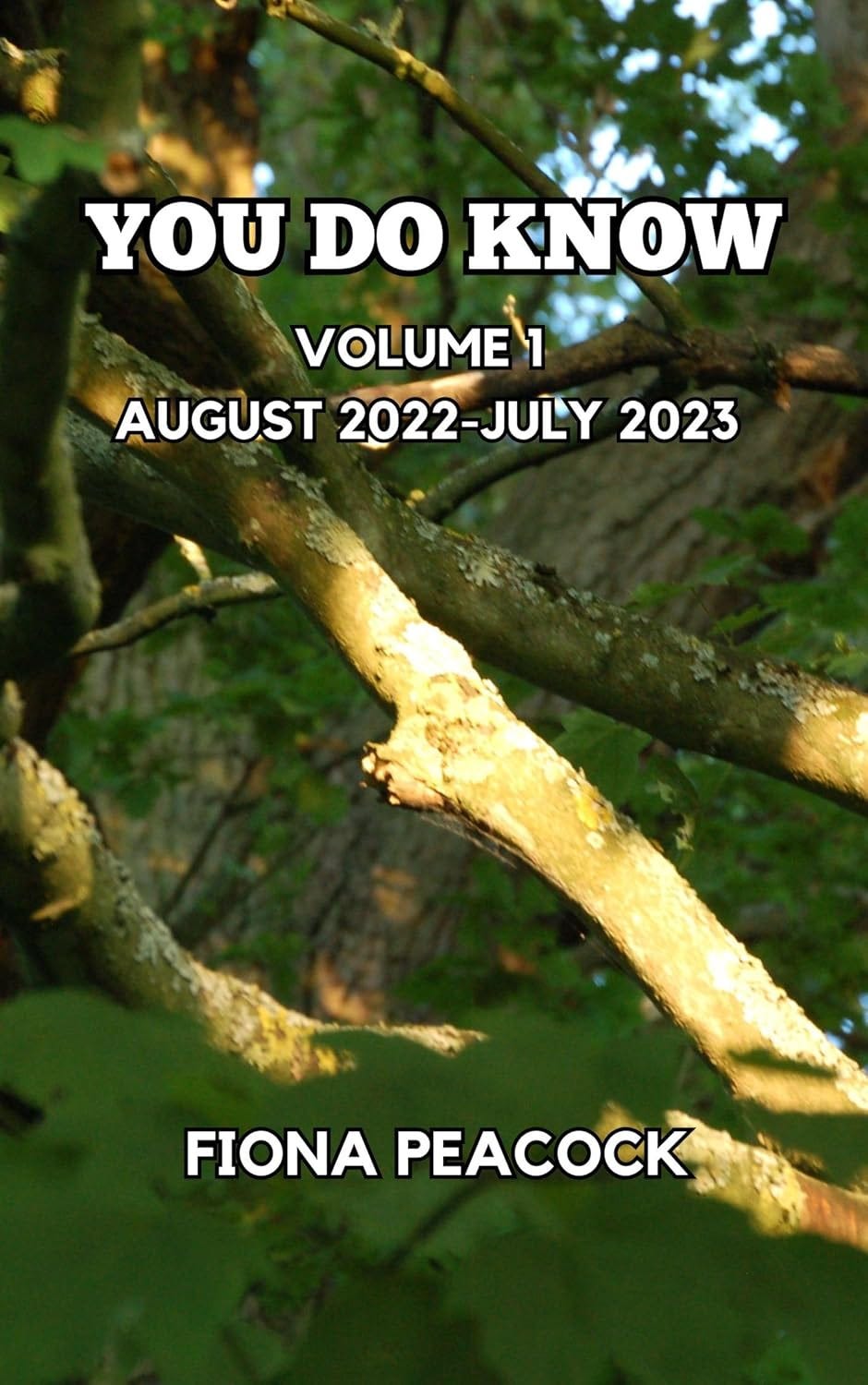
The first year of You Do Know is now available in a collected edition, in both Kindle and paperback formats. All posts will remain free to read on Substack, and buying the book is entirely optional. It’s simply an alternative way to access and engage with the blog for those who prefer it, as well as a way to support the ongoing production of the free-to-access blog.
The Kindle edition is available on Amazon for £8, and can be purchased from anywhere in the world.
In the UK, paperback copies cost £13, including postage, and can be ordered directly from me via this Google Form. For orders outside the UK and EU, the paperback copy is £13 plus postage - please contact admin@peacockcounselling.com to arrange this. Unfortunately, the paperback is not currently available for purchase within the EU.
Below is the book’s preface, written by David Myrow.
This inventive book is about the experience of using Theraplay®, a unique modality for child and parent therapy. The author paints the picture of how the therapist thinks and intervenes, what the child and parent experience, and how the work can evolve in a social setting. Just at this level, it is a must-read for anyone working with children and their families when the children have experienced attachment trauma. While it is especially apropos for those training in Theraplay, the work speaks boldly to anyone attempting work with this challenging population.
There is plenty of nuance in showing the complexities of working with this population. Peacock’s observations go well beyond the Theraplay modality and venture into the nature of the therapy experience. She shares her research into how we understand what it means to learn how to do therapy and how we know of its value. She notes the profound limitations of the usual ‘evidenced-based’ ways of affirming the worth of therapy. The author explores the concept of ‘m/othering’ as an alternative way of knowing what is helpful to people, one based on the ‘tacit knowing’ of mothers. She asks how one person can help another without ‘othering’ that person. The author emphasises the critical variable of the quality of the relationship, something researchers have struggled to objectify for decades.
Peacock depicts in detail the feelings and thoughts of the therapist, the parents, the child, and even the other professionals (teachers, social workers) who enter into the equation when children are being considered for adoption.
It may be difficult for those not trained in Theraplay to fully comprehend the scope of the effect on the therapist. One of the first therapeutic approaches founded in Attachment Theory (Bowlby, 1999), it pulls together what we know about human bio-neurological-social development and places it the context of healthy early experiences. When Ann Jernberg started building this approach in the 1960s (Jernberg, 1979) she anticipated many findings in scientific research that support it. Instead of focusing on pathology, Ann turned to observing parents and children playing and interacting in typically healthy ways. She sought to find ways to recreate these experiences in a hands-on way with children and their parents who were struggling. Phyllis Booth (2010), who studied with Bowlby, supported Ann’s work and after Ann’s passing, linked it expertly to the quickly evolving body of child development research in the past few decades.
Theraplay derives its strength from its basis in right-brained, pre-verbal, and social understanding of what goes on in the work. This gives it an advantage at being able to access difficulties that trace back to disruptions in early relationships. This is not a Talking Therapy! The therapist uses physical but highly–attuned connection with children and their parents. It is not an approach that focuses on the child alone. It is an approach that requires the therapist to provide Structure, Engagement, Nurture, and Challenge (the four pillars of parent–child relationship in the Theraplay approach) with immediacy and empathic attunement.
When someone experienced in more traditional approaches comes to the first training in Theraplay, it is usually a shocking moment. The work is so immediate and personal! The student is invited to participate in the same playful and fun experiences that their clients will get to know. With the extensive training that one gets to become a Theraplay therapist, there is profound self-knowledge and self-acceptance that makes it possible to be a more effective therapist. The required self-exploration and dedication is transformative. But the depth of awareness also puts great demands on the therapist.
Peacock details this process in beautifully-written prose. Most of all, she characterises Theraplay as a ‘way of thinking,’ not just a model with prescribed strategies. She draws from the novella she wrote to illustrate this work A Necessary Life(Story) vis–a–vis the scientific and theoretical basis for Theraplay. The overall method is reminiscent of Daniel Hughes’ book Building the Bonds of Attachment (2018) in how it depicts, from the points of view of the parents, therapist, and social worker, the challenges of working with children who have experienced profound attachment trauma. Yet Peacock’s book goes much further, not only in depicting the Theraplay approach but in challenging our way of thinking about the helping process, about the standard of proof that we require to establish efficacy, and in emphasising the personhood of the therapist in creating a meaningful relationship with the child.
As the reader will see, the author turns to inherent, intuitive ‘knowing’ that permits competent mothers to be attuned to their children’s feelings and needs. And yet it correlates with the skilfulness of a successful therapist. Considerable research argues that fathers also contribute to a child’s development, but not in the same foundational way. In fact, Theraplay therapists can learn much from this father–child research, especially when working with older children (Myrow, 2023).
As someone who has worked as a Theraplay Therapist and Trainer for over 40 years, I am impressed with how accurately and beautifully Dr. Peacock portrays the experience. She raises good questions for anyone working with families. She shows the painful challenges of working with other professionals who do not share the same understanding of child development from an Attachment and Trauma-informed perspective. In my mind, this work shares the space with Carl Rogers’ (1961) On Become a Person: A Therapist’s View of Psychotherapy in its capacity to challenge therapists and psychotherapy researchers.
David L. Myrow, Ph.D.,
Clinical Psychologist, Theraplay Institute Affiliate Trainer, Co-recipient (2011) Ann M. Jernberg Award, Clinical Assistant Professor of Psychiatry at the University at Buffalo
Bibliography
Brennan, S. J. (with Noggle, R.). (2007). Taking Responsibility for Children. Wilfrid Laurier University Press.
Dei, G. J. S., & Jaimungal, C. S. (Eds). (2018). Indigeneity and decolonial resistance: Alternatives to colonial thinking and practice. Myers Education Press.
Drydyk, J., & Keleher, L. (Eds). (2019). Routledge Handbook of Development Ethics. Taylor & Francis.
Gordon, W. T., & Lubell, A. (2015). Saussure For Beginners. For Beginners.
Jernberg, A. M. (1979). Theraplay: A new treatment structured play for problem children and their families. Jossey-Bass Publishers.
Karagiannis, N. (2010). Avoiding responsibility: The politics and discourse of European development policy. Pluto Press.
Lakoff, G., & Johnson, M. (2003). Metaphors we live by. University of Chicago Press
Vartan, S. (2025). The Stronger Sex: What Science Tells Us about the Power of the Female Body. Atlantic Books.