
Nuggets of the m/other land

Contents
Chapter 3: 17:00
A bit of a nappy post: poop, clean, cuddle, rest, repeat!
Addition for the m/other-us-all
Introduction
This post marks a full year of this project. I have a loose five-year span in mind, much like a part-time doctorate. And you, dear readers, are the supervisors, peer reviewers, and examiners who will ultimately judge whether I manage to shape a coherent way of thinking about how our work, whatever form it takes, can be rooted in love and care. Over this first year, I have become clearer that this is what I mean when I talk about ‘operationalising our m/other tongue’.
Tacit maternal knowing has become my main lens for understanding how the world works. In Theraplay terms, it is taking Jernberg seriously and thinking about the mother and infant/child as the primary model for what we do and why we do it. Taking that as my staring point, right now I feel as if I’m slumped beside the cot, watching the baby. While in the manstream, the end of a year might lead to an organised, systematic, and linear review of work so far, I’m too wrung out to reflect, my head racing through a list of jobs, while my body folds under the sheer too-muchness of it all. Do those of you who have had babies remember those days?
In the language of Heuristic Inquiry, I am in a blend of incubation and immersion – a necessary, embodied pause. But the voice of the manstream dictator in my head keeps muttering that rest is unproductive, urging me to produce, produce, produce. Two concepts that have only recently become active in my thinking - the toolbox and the changing bag - are at odds with each other. Do I progress this theory of care by tinkering with parts that don’t seem to function using tools that don’t quite fit, or do I keep cleaning the baby/ideas up while delighting in them? What recommendations will eventually emerge from this live contest about how we are people who care, across our various professional roles?
And so, a year ago, caught up in the frenzy of NaNoWriMo and trying to write from my m/other tongue, this fiction emerged.
It is 17:00 hours at the service station.
Ramping
The sigh escaped, Val internally deflating as she released her breath. And breathe, she told herself.
Now there was nothing outside but inky blackness, broken only by the stationary headlights, refracted through the rain into twinkling fairy lights. Even those were beginning to wink out as the occupants of the metal boxes realised they were going nowhere any time soon.
On the far side of the motorway, traffic still moved, though slower and slower. Something deep within her balked at the sheer wrongness of it all: traffic ought to keep flowing, lights ought to keep shining. When they did not, it felt as though the world itself were coming to an end.
Graham was holding his phone up for her to see, and she duly turned her attention towards it. The news website reported that the motorway was closed by a serious accident between them and the next junction. Traffic was being diverted, but that junction was eight miles back, so now there was eight miles of unmoving car park between there and here, plus another eight miles to the following exit.
Val’s phone pinged.
“We’re stuck,” Graham said. “No one is coming to change our tyre today.”
Val looked at the message on her phone and then held it up to Graham. “We are pleased to say you are next in the queue, and our operative will be with you shortly,” Graham read. “Don’t think they’ve read the news,” he added with a dry laugh.
There was something about his laugh that pushed Val back into her academic head, not that she could recall chapter and verse as she might once have done. Sarah Blaffer Hrdy wrote somewhere that if you filled a plane with apes, by the time the flight landed there would be torn limbs and missing digits. Val shuddered. As much as she valued Hrdy’s academic work, the sentiment felt uncomfortably close to home. The food hall was starting to feel like a packed flight.
There were raised voices by the sandwich shop.
“What do you mean you’ve run out of bread?”
“We were expecting our delivery at four. It must have got caught in the traffic.”
The argument rolled on. The worker stayed calm, the hungry driver outraged, refusing a burger, refusing compromise, wanting only what he wanted, and wanting it now. Hrdy had written about altruism as a defining human trait, but here and now, that grip felt painfully thin.
Val felt herself swept up by the sheer too-muchness of it all, carried along by a current that refused to stop. Then, like an unexpected eddy whipped up in a river struggling with too much rain, the tension shifted. It rippled on until it snagged again – an accusation of queue-jumping that bubbled and chopped its way into a burst of swearing. A whirl of bodies moving from one place to another; another pocket of friction as someone returned to find a stranger in their seat, anger surfacing despite the flustered apologies.
Val glanced across the crowded hall towards Daniel and the group of children he and his staff were caring for. She worried that the ripples and eddies of tension might be reaching them, already primed, she imagined, to be acutely aware of any hint of trouble between people. A sea of bodies lay between her and the group. Every so often the crowd shifted, giving her a brief view. It was as though Daniel had managed to raise an invisible windbreak around them, their attention held tightly within their own little circle. In the fleeting glimpses she caught, she saw adults working hard to connect with the children, contain their distress, and steer them away from overload.
Outside, the rain hammered on without mercy. Val could feel her own tension rising – all these people, all this desire to move, all this being trapped. She pressed her hands to her face, rubbing her cheeks as she scanned the room. Her whole body felt primed for conflict, every instinct urging her to step in and defuse some potential clash. She pushed herself upright, her chair scraping loudly across the floor.
“I need to go to the toilet,” she said.
“Do you?” Graham asked.
She shook her head in tiny movements. And breathe, she reminded herself again.
She sat down. Were people looking at her? Did it matter? She hid her hands under the table, clenching and unclenching them, eyes closed as she tried to slow her breath. In for four; hold for four; out for four; hold for four. Pointless. It never worked, so why was she even trying?
She pushed her hands into her hair, eyes opening wide, then blew out through her lips before looking at Graham. “It’s tense in here,” she said.
He nodded.
“We could walk over to the other side of the motorway, see if it’s any less crowded,” he suggested.
Any movement, Val felt, would be a relief. They stood and gathered their things. It was as though scavengers were watching, waiting, circling. The moment they stepped away from their table, the chairs were taken, like a relinquished kill ready to be cleaned up. Val could almost hear the sighs of relief from the couple who slid into the vacated places, their pressing needs now met.
Movement, and acknowledging the relief of met need in others, made it possible for her to feel less like it was all her fault, and so less like it was down to her to manage the entirety of this seething anxiety. It made it possible to smile again at the awareness that this was a dilemma of humankind, caused by the world on them, the weather being bigger than all frail humans put together. It even let her smile at the thought that this could be a primate dilemma; humans a mere footnote of the trials of being together when things are tough. Thank you, Sarah, and your primates on the plane, she thought.
Trying to get to the stairs to the covered walkway that led to the opposite side of the motorway was like trying to pick one’s way through a crowd at a football match. There was no path and no clear flow of people. The purposeful stride Val longed for was impossible. The sounds pressed down on her, loud but incomprehensible.
Graham, with his broader frame and generally more commanding presence, pushed ahead. He glanced back at her. Amazing how expressive his eyebrows can be, Val thought. She gave a small nod. Graham changed course, and eventually they reached the entrance door. They stepped outside, turning left, huddling under a narrow overhang that kept most of the rain off of them. At least it gave them a little space away from the crush.
This time it was his right eyebrow that raised - a query: would we be better off waiting in the car? She pulled her head back, knowing it made her chin go double but not caring, her right nostril wrinkling, an emphatic response of you’ve got to be kidding, we’d be drowned rats before we got there.
They stayed outside for as long as they could, until standing on hard concrete, the dampness, and the relentless hammering of rain on cars and roads became more unbearable than the heat and noise of people inside.
“At least no one new is arriving now,” Graham said. While they’d stood there, a few bedraggled souls had trudged up from the motorway, abandoning their cars in hope of respite at the services. Val kept expecting someone in authority to turn up – police, traffic officers, anyone – to manage the situation or offer information. But no one came. They seemed entirely on their own. Civilisation felt frighteningly thin.
Still, the time outside helped her regain some of her equilibrium. She felt like her grown-up self again.
Inside, movements had slowed. Families were claiming whatever patches of floor they could find, spreading coats to soften the cold hardness. The fevered intensity had ebbed a little. People’s talk was now quieter, more resigned. As Val and Graham picked their way through the too-bright, too-small space, they searched for somewhere they could settle and ride out whatever this was – this strange halt to normal life.
They found a spot with a bit of wall behind them for support. A little further along she spotted Daniel, arms around two children who looked asleep, though she suspected it was more shutdown than sleep. They couldn’t cope, but they trusted him enough to let him hold them, protect them, create a pocket of safety where they could retreat rather than fight.
“You look tired,” she said to Graham.
“I am,” he replied. “I’m getting old. The unexpected gets tougher.”
She nodded. She was not sure if she looked tired, but she certainly felt it. They leaned into each other, the shared warmth grounding and heavy in a comforting way. Val let her head rest against the wall and slipped into her own sort of shutdown – not sleep, but a turning off of anything not essential. She had not known it was a survival mechanism until this moment. It was simply something she had always done.
A bit of a nappy post: poop, clean, cuddle, rest, repeat!
A year into the project, and this idea that I am trying to rest and digest – trying to reflect on where I have got to, and where I have to go – brings up so many of the questions that have been lurking throughout the year. So many posts about maintenance, the importance of boredom, being able to do nothing, and these as essential to staying with the troubled, understanding what work is, and, ultimately, asking how we go about our business from a foundation of kinship and care, not commerce and exploitation. Put like that, I have covered a fair amount of ground in a year.
How has it been for you? Have you found any answers in all this writing that help you in your efforts to care across the various roles you work in? Any answers to the research questions you set me?
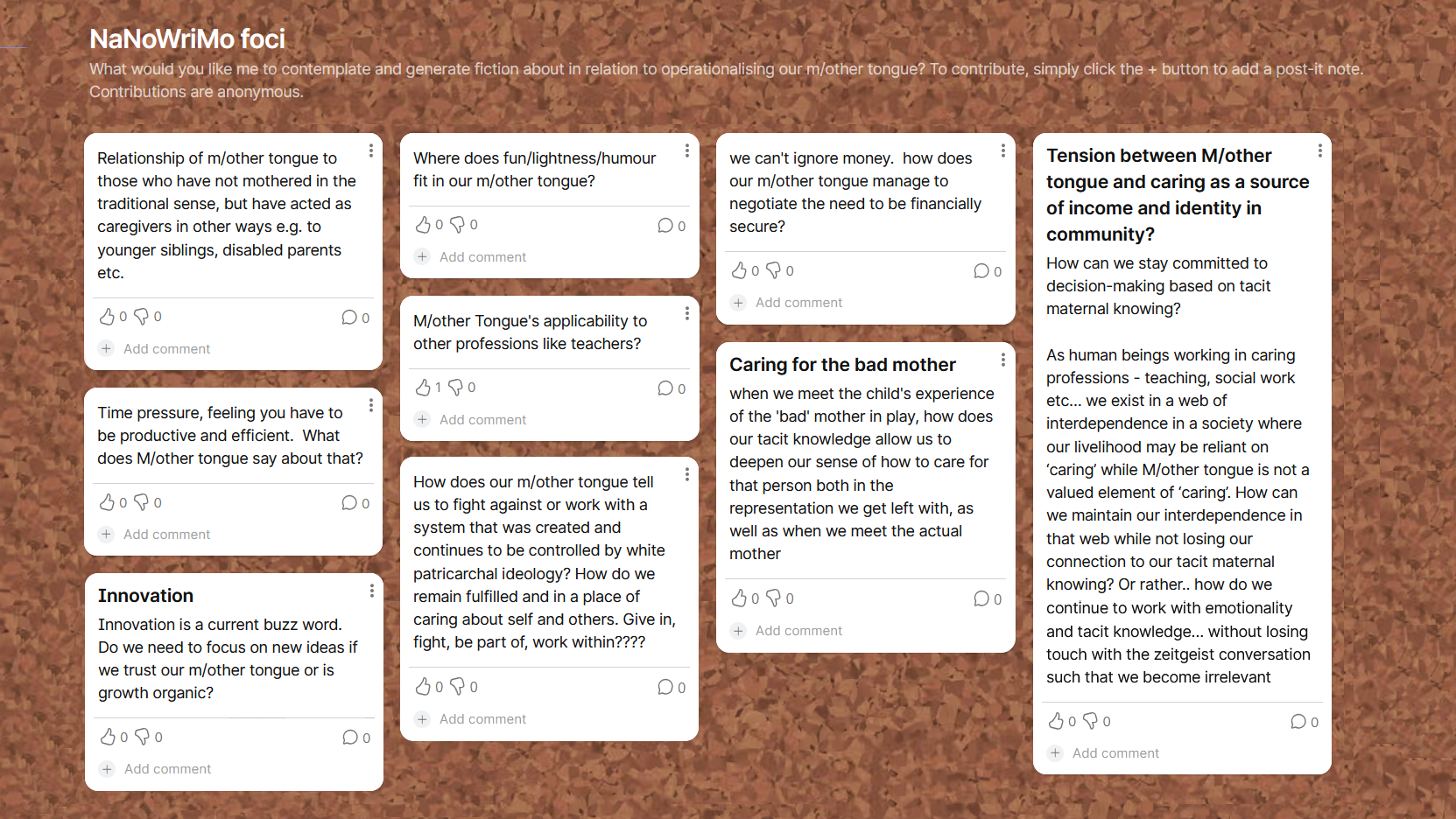
When I re-read the fiction, I initially felt quite clueless about what my tacit maternal knowing might be telling me. I had no idea what to write, or where it was going. I still feel that I do not know what is in the changing bag. In reviewing the areas I have begun to explore this year, and realising how much ground I have covered, I again feel the oppressive limits of the toolbox. The fiction is about being trapped somewhere against your wishes and your way of being, with no means of escape. Within that entrapment, no-one is really seeing how hard some people are working to stay connected to their commitment and vocation to care. And how some need to take a break in order to keep that commitment alive.
That is the reality of the world we live in. I may have my flights of fancy, my dreams of a utopian m/otherland, but the reality is that we are living within a pervasive and highly contagious WEIRD (western, educated, industrialised, rich, democratic) and WSCP (white supremacist capitalist patriarchy) dominance. The master’s house, tools, and toolbox are still firmly woven into the fabric of the world around me. They continue to define expectations of what counts as ‘normal’ for vast numbers of people, and they shape what comes to feel like ‘safety’ – earning money, having a job, not relying on others. Experiences of speaking our m/other tongue, of prioritising care over profit, remain largely invisible and, when they are visible and celebrated, they are often torn down (I am thinking of Kids Company: see this, this, and this for different flavours of reporting), deemed deviant, high-risk, and potentially criminal.
Dipping back into the fiction, I feel suffocated. I was doing some CPD on phobias and was fascinated to learn that the word ‘agoraphobia’ stems from women not being allowed into the marketplace (the agora), so entering it as a woman was high-risk and could have led to readiness to flee if discovered (Morgan, 2019). In all the years I struggled with agoraphobia, I never knew that – or perhaps I was not in a place to hear it. Now, as I ponder how to enable our m/other tongue to be spoken freely in the marketplace, so to speak, I can begin to unpick why it is so difficult to get this way of constructing the world heard, seen, digested, and used. I should not be here, but I am.
The capitalist patriarchy has trapped Val and Graham at the service station through the algorithm of the breakdown company and the capitalist pursuit of Halloween fun at the end of half-term fuelling the traffic on the motorway. Add Mother Nature and her mega downpour, and the vestiges of individual control are wiped out. The double bind of no choice, yet being in the wrong place.
Support comes from unexpected places as I reflect, ponder, wonder, and fret about whether each month’s struggle to produce a post is worth anything.
The logic of algorithms tends to repeat what ‘works’, but art opens up what is possible. Not everything has to be immediate or predictable. Defend slowness when it serves a purpose, silence when it speaks, and difference when evocative. Beauty is not just a means of escape; it is, above all, an invocation. When cinema is authentic, it does not merely console, but challenges. It articulates the questions that dwell within us, and sometimes even provokes tears that we did not know we needed to express.
Pope Leo was speaking about cinema, but I believe what he says applies to all arts-based approaches to making sense of (researching) challenging social phenomena.
Each month, I push against the resistance within me to discover meaning. I labour. At times, it borders on distressing. But for me, it is necessary, though not pleasant, because it reveals the tears I did not know needed to be expressed. It reveals how hard it is to allow the world to be organised around the unique experience of one becoming two. To take that physical experience and turn it into a construct, a theory of being, is another invisible labour of our m/other tongue – how our tacit maternal knowing might be apprehended, not just inwardly, but offered to the world. We are working in a landscape where the culture does not make space for our m/other tongue. People like Daniel and Val have to carve out, and actively defend, that space within the manstream, so that these nuggets of the m/otherland can do their work in the service of others: to care.
Through reflecting on this fiction, I am developing a growing understanding of how paternal aspects of parenting fit here, enabling the defence of those nuggets. Looking ahead to the next year’s worth of research, I find myself wondering whether the necessary splitting of maternal and paternal function that I see in Val and Graham’s relationship (so that I can examine them) might become more integrated in my theoretical position. Daniel seems, somehow, to be telling me that I already know how this works.
I am hoping, and also wondering, whether enough nuggets of the m/otherland can join up. The fiction may continue to tell me how this might happen as I attempt to deduce a theory that supports us to work through our m/other tongue. In constructing theory, I hope to create a place where voices can gather, strong enough together to shape the practice of care. I hope that enough of us can take up such theory that it becomes less of a fringe idea and more of a mainstream one.
The m/otherland is the place where the m/other tongue is the first language spoken. A place where people are communal and affirming. Whereas, in the manstream, it is every person for themselves, focused on survival – a place where the foundations of trauma, too much for too long with no other to care for you, are built in as normal – the m/otherland is where the impulse is to work together for the good of each and every person in the community. Using oneself in the service of another is the norm. Equity here means people getting what they need, each in response to their need, so that mutual flourishing becomes possible.
Val has pushed against the tide of too-muchness in the ‘real world’, and she has sat alongside children as they struggle with their own ‘too-muchness’ in the Theraplay room. The toolbox wielded by the manstream for so long has pushed me to a place where, for me to be doing real work – whether in this research or in my Theraplay work with children – I feel I have to prove that this (what I do, what I think, what I believe) is the answer, something that, if others copied it exactly, would cure everyone.
The problem is not that we don’t have the answer. I want to say again so you don’t miss it: we do have the answer. The answer is that we care, we love, and we notice the one person in front of us, or the small group where we have the human capacity to know each one fully. The issue is that to accept the answer to the world’s problems, people with power would have to give up power; those for whom acquisition is preservation of their power would have to give up acquiring for its own sake; the powerful purchaser would have to accept they need to adapt, that their need will be met, but not necessarily their desire. The bread has not been delivered, but the burger bun is available.
The answer is that our world could could operate by giving each according to need, at the point of need, freely given and freely received. That is the m/otherland I long for. We can either organise our lives around the fear of exploitation, or accept that humans, on the whole, are social and positive – that too much for too long, with no-one to help, pushes people towards violence (towards themselves or others, visible or hidden), and that there will always be outliers, whom we must love too, minimising their impact rather than blaming them. We cannot prevent too much for too long; the world is full of disasters born of the Earth itself, never mind the man-made ones. But we can change the ‘with no-one with you’, so that challenge does not have to become trauma. We can work at being alongside each other.
Theraplay is family, and the making of attachment bonds. In operationalising it – taking it out of the therapy room and into life as a whole – we are asking how it applies to crowds, groups, and communities, and whether the sense of family continues. Motherhood is altruism – giving your body over to host another body, never to be the same again, putting your body on the line for another. Operationalising our m/other tongue means taking mothering into the wide world, and perhaps being changed forever by doing so.
In another part of his speech, Pope Leo said (again, replace cinema with art):
One of cinema’s most valuable contributions is helping audiences consider their own lives, look at the complexity of their experiences with new eyes, and examine the world as if for the first time. In doing so, they rediscover a portion of the hope that is essential for humanity to live to the fullest. I find comfort in the thought that cinema is not just moving pictures; it sets hope in motion!
My hope is that this arts-based research project, using Heuristic Inquiry, will ultimately make a difference to your lives, and to the lives of the children and families we care about. I also have to have trust – trust in myself and my tacit knowing, and trust in the process.
I will finish with more words from Pope Leo that give me the courage to keep going:
In the present era, there is a need for witnesses to hope, beauty, and truth. You can fulfil this role through your artistic work. Good cinema, and those who create and star in it, have the power to recover the authenticity of imagery in order to safeguard and promote human dignity. Do not be afraid to confront the world’s wounds. Violence, poverty, exile, loneliness, addiction, and forgotten wars are issues that need to be acknowledged and narrated. Good cinema does not exploit pain; it recognizes and explores it. This is what all the great directors have done. Giving voice to the complex, contradictory, and sometimes dark feelings that dwell in the human heart is an act of love. Art must not shy away from the mystery of frailty; it must engage with it and know how to remain before it.
Addition for the m/other-us-all
The radical shift that enables us to speak our m/other tongue as a first language is to reposition the embodied experience of conception, gestation, birthing, feeding, and infant care. For research, this becomes a matter of ontology and epistemology; for practice, it becomes the primary reference point for understanding human motivation, desire, and resistance – grounded in the mother and infant relationship. If I can hold this within myself in a consistent and non-defensive way, then I think I will have climbed out of the toolbox and begun to fill my changing bag.
Bibliography
Hrdy, S. B. (2011). Mothers and others: The evolutionary origins of mutual understanding. Belknap.
Morgan, S. (Ed.). (2019). Phobia: A reassessment. Routledge.